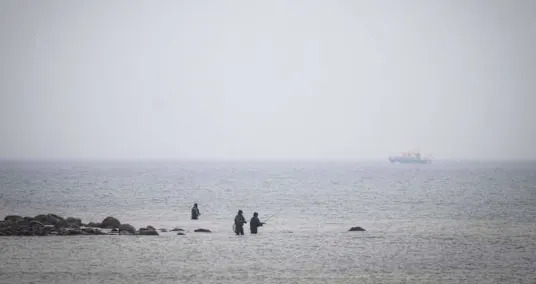
A humpback whale stranded for days off Germany's Baltic coast has gotten stuck on another sandbank, a Greenpeace spokeswoman said on Saturday.
The unlucky animal had garnered media attention for days, after it got stranded on a sandbank off Germany's Timmendorfer Strand resort, near the city of Lübeck, early on Monday.
Days of efforts to free the 12- to 15-metre whale proved unsuccessful until rescuers dug out a channel in the sand around the animal using a floating excavator on Thursday, allowing the whale to swim free the following night.
However, environmentalists and marine experts had feared that the animal could potentially get stuck again, as it was spotted heading back towards shallower water following its release.
Those fears became reality on Saturday, with the whale spotted stranded on a sandbank in the Bay of Wismar, some 40 kilometres to the east of Timmendorfer Strand, according to Greenpeace.
Large whales such as humpback whales are not native to the Baltic Sea. They may follow schools of fish in search of food and end up in the Baltic Sea.
According to experts, underwater noise could also play a role.

LATEST POSTS
- 1
 75% of Arab Israelis support Arab party joining government coalition post-war, survey reveals
 - 2New materials, old physics – the science behind how your winter jacket keeps you warm
- 3James Webb Space Telescope watches 'Jekyll and Hyde' galaxy shapeshift into a cosmic monster
- 4When will the Epstein files be released — and will they reveal anything new?
- 5How a seabird native to Hawaii has adapted to life in Honolulu's concrete jungle


- ‘More should be done’: UN pushes Syrian regime on justice for Druze, Alawites and minority groups
- UN torture cm'tee report flags Israel for allegedly mistreating journalists, detainees, ex-MAG
- As juries turn against social media for harming kids, Big Tech's invincibility starts to show cracks
- Cameroon says Russia has confirmed 16 Cameroonian soldiers died in Ukraine
- How do my eyes adjust to the dark and how long does it take?
- European Travel Objections for 2024
- Mussolini's summer villa on Adriatic coast sold for €1.2 million
- Virtual reality opens doors for older people to build closer connections in real life
- First foreign troop in new gang suppression force lands in Haiti to replace previous mission